FAQ Notes


Mental Math and Reflexes

Every lesson contains a suggested Mental Math and Reflexes problem set. These are designed to strengthen students' number sense, review and advance essential skills, and develop and solidify mathematical knowledge. Exercises focus on the following six topics (though not exclusively):
  • Integer Operations
  • Estimates of counts and measurements
  • Reference frames
  • Measurement
  • Different names for a number
  • Rational-number operations

Mental Math and Reflexes exercises are intended to be used at least three times per week. However, as the name implies, it is not necessary or desireable to spend more than 5 minutes per session on them. You should not feel compelled to do all the suggested problems for each lesson. Numerous short interactions are more effective than fewer prolonged sessions.

When teachers begin a new topic, the recommendation is to find the level at which the majority of the students succeed, then begin work at a level slightly above it. The starting level may change from class to class and year to year, because the mathematical knowledge that students bring with them will vary. Where appropriate, exercises are provided that deal with the subskills for a given topic. Give each exercise orally. (If large numbers are involved, it may be desireable to write them on the chalkboard to reduce memory demands.)

  • Students try to work mentally.
  • Students write their answers on their slates and keep them covered. (Students can write notes and intermediate steps on their slates, but they should not carry out a written algorithm.)
  • When most students have answers (sufficient wait time is important), give a signal for them to show their slates. This allows you to make a quick assessment of the class's success. Adjust the level of difficulty according to the success of the class.
  • Ask students to share their strategies for the more difficult problems and to explain their answers.

Math Boxes

Math Boxes, which were suggested by Ellen Dairyko, are a marvelous way to review material on a regular basis. Everyday Mathematics includes Math Boxes for almost every lesson.The Math Boxes are divided into boxes, or cells. Some of these cells contain review problems.

Each Math Boxes page is designed for use as an independent activity. Children may work on their math Boxes individually or with partners. But do expect to offer some guidance, especially at the beginning of the school year.

Return to FAQ Index

Home Links/Study Links

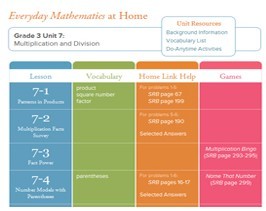
Dialog and discussion as well as experimentation are at the heart of Everyday Mathematics. Parents who have been accustomed to conventional mathematics programs may think that, because children are not bringing home daily arithmetic sheets, they are not learning or doing mathematics. The Home Links serve as reassurance that this is no the case. Home Links activities serve three additional purposes: They

  • promote follow-up
  • provide enrichment
  • provide a means of involving parents or guardians in their children's mathematics education

Still more reasons for using Home Links throughout the year include the following:

  • The assignments encourage children to take initiative and responsibility.
  • The activities help reinforce newly learned skills and concepts.
  • Many of the assignments relate what is learned in school to the children's lives outside of school. This helps tie mathematics to their everyday world.
  • The assignments can serve as informal assessment tools.

Most of the Home Links are homework assignments that require interaction with parents, other adults, or older children. Since primary caregivers or those likely to help with the homework are not necessarily "parents", Home Links say to do the activity with someone at home. At the beginning of the year, you might send home the "Parents' Introduction to Everyday Mathematics" Parent letter. Continue to involve families throughout the year by sending home unit-specific letters that explain the content that will be covered. Everyday Mathematics also provides some Parent Letters that are meant to be sent home with particular Home Links (both the letters and the Home Links are labeled with the lesson numbers.) These letters explain an idea or an activity that might be new to parents.

A number on each Home Link matches the number of the lesson with which it is to be used.

Return to FAQ Index

Fact Families

Everyday Mathematics has found that young children not only can understand the inverse relationships between arithmetic operations (addition "undoes" subtraction, and vice versa; multiplication "undoes" division, and the other way around), they often "discover" them on their own. In First and Second Grade Everyday Mathematics, the inverses for sums and differences of whole numbers up to 10 are called the basic fact families. A fact family is a collection of four related facts linking two inverse operations. For example, the following four equations symbolize the fact family relating 3, 4, and 7 with addition and subtraction:

 3+4=7    4+3=7    7-3=4   7-4=3

You may recognize that the two addition facts in the family above are instances of the commutative property of addition. Although Everyday Mathematics does not require that children learn mathematical names for properties, occasionally it is handy to have some name to use, so Everyday Mathematics calls the commutative property of addition the turn-around rule for addition. From a practical point of view, the turn-around rule means that any time you learn a new addition fact, you get a second one for free! There is no turn-around rule for subtraction; e.g., 7-4 and 4-7.

Everyday Mathematics calls properties of arithmetic shortcuts. The four facts in a fact family are all related by shortcuts. A major reason for teaching fact families is to give children ways to solve problems that may seem new or difficult by remembering a shortcut and then rewording or rewriting the problem. For example, faced with 7-3=?, a first grader may think, "Hmm, I don't know. What plus 3 is 7? Ah, that's easy, it's 4."

Beginning in second grade, children learn the basic multiplication and division facts and fact families. In all grades, new facts are usually introduced through games; in early grades, by concrete manipulations with dice or dominoes and by a connection to previously known facts. Fact extensions are powerful mental arithmetic strategies for all operations with larger numbers. They begin in first grade and are extended throughout the program. For example, if children know 3+4=7, they also know 30+40=70, and 300+400=700. If children know 6*5=30, they also know 60*5=300, 600*5=3000, 3000/600=5, and so on.

Return to FAQ Index

Games for Drill and Practice

Frequent practice is necessary to attain strong mental arithmetic skills and reflexes. Although drill focused narrowly on rote practice with operations has its place, Everyday Mathematics also encourages practice through games.

Drill and games should not be viewed as competitors for class time, nor should games be thought of as time-killers or rewards. In fact, games satisfy many, if not most, standard drill objectives - and with many built-in options. Drill tends to become tedious and, therefore, gradually loses its effectiveness. Games relieve the tedium because children enjoy them. Indeed, children often wish to continue to play games during their free time, lunch, and even recess.

Drill exercises aim primarily at building fact and operations skills. Practice through games shares these objectives, but, at the same time, games often reinforce other skills including calculator skills, money exchange and shopping skills, logic, geometric intuition, and intuition about probability and chance (because many games involve numbers that are generated randomly.)

Using games to practice number skills also greatly reduces the need for work sheets. Because the numbers in most games are generated randomly, the games can be played over and over without repeating the same problems. Many of the Everyday Mathematics games come with variations that allow players to progress from easy to more challenging versions. Games practice, therefore, offers an almost unlimited source of problem material.

If you would like to see some sample games, click HERE.

Return to FAQ Index


Top of Page | Home | Educators | Parents
Students | Updates | Contacts

Web site copyright © 2008 UCSMP